
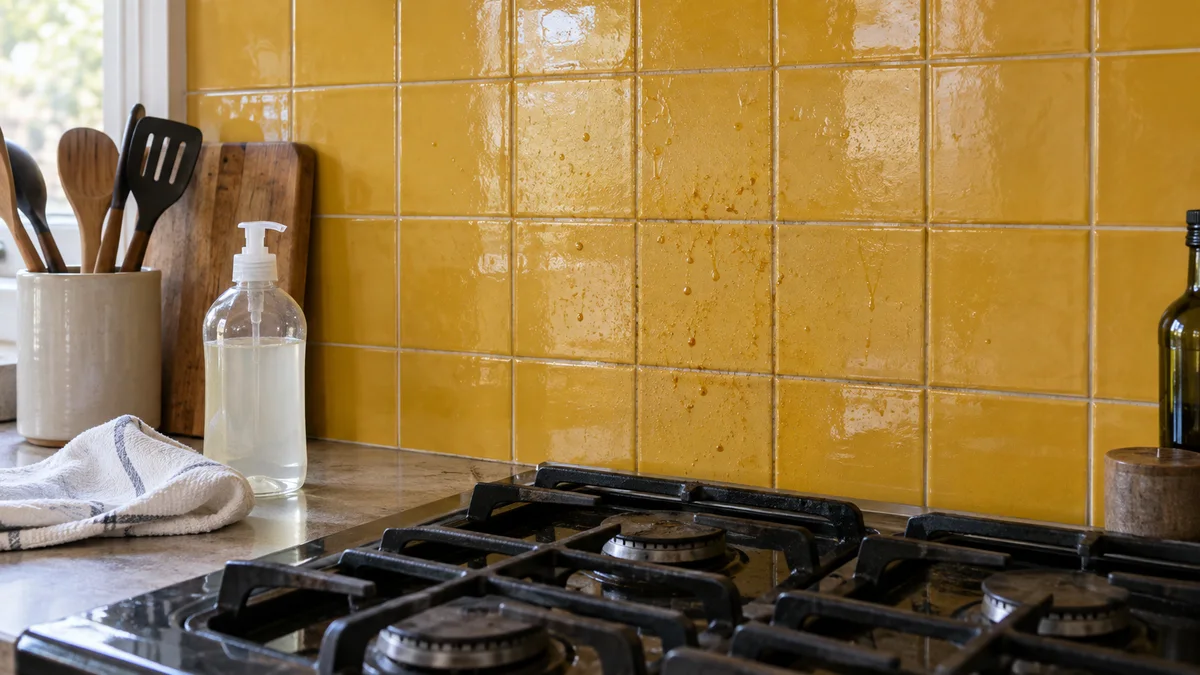
Prepare the kitchen
Set up the kitchen before opening a bottle
Move food, utensils and small countertop items away from the work area. Remove loose crumbs with a compatible method so they do not become grit under the cloth. Read the chosen product’s dilution, ventilation, contact-time and rinsing instructions before applying it.
Use clean cloths and change to a fresh surface as grease transfers. A saturated cloth can spread a thin film across a larger area. Keep cleaning products in their original containers and never combine them. For chemical-safety context, see the CDC guidance on household cleaning.
Choose the surface you are cleaning
Painted or finished cabinet fronts
Identify the cabinet finish and follow its care instructions. Grease often collects around handles and above cooking areas. Use the gentlest compatible cleaner and a soft cloth, avoiding excess moisture at joints, edges and unfinished areas. Test an inconspicuous location where the instructions recommend it.
Do not leave a wet cleaner sitting on the panel simply because the stain is stubborn. A long dwell time that is suitable for tile may be unsuitable for a painted door. Dry as directed and check after drying. If the finish becomes tacky or dull, stop rather than scrubbing harder.
For swollen edges or doors that have changed shape, cleaning is not the repair. Use the cabinet door troubleshooting guide to distinguish surface residue from alignment or moisture damage. Keep hardware adjustments separate from the cleaning session.
Tile and grout behind the stove
Confirm whether the backsplash is ceramic, porcelain, stone or another material. A cleaner must be suitable for both the tile and the joints. Natural stone and cement-based grout can be damaged by acidic recipes. Do not assume that a smooth shiny surface is ordinary ceramic tile.
Work in a small section with the approved solution and a nonabrasive tool. Rinse and remove residue as instructed, then dry. If grout is cracked or loose, avoid driving water into the damaged area. The grout cleaning guide provides a more detailed material-first sequence.
Stainless steel appliance fronts
Check whether the surface is conventional stainless steel or a coated, fingerprint-resistant finish. Follow the appliance maker’s instructions. Use a clean soft cloth and work with the visible grain when appropriate. A method for uncoated stainless may not be suitable for a dark or fingerprint-resistant coating.
Keep liquid out of control panels, seams and ventilation openings. Do not use steel wool or a gritty cloth to remove grease. If streaks remain, reassess residue and drying rather than immediately adding polish. Our stainless steel care article compares grease, water marks and scratches.
The cool cooktop
Use the instructions for the exact cooktop material and appliance. Glass-ceramic surfaces, gas burner assemblies and coated components have different care requirements. Confirm that the surface is cool and the appliance is in the state its manual requires before cleaning.
Do not remove burner components or use a scraper unless the manual describes the method and appropriate tool. Avoid flooding openings and never spray into electrical or ignition parts. If residue is baked on and the approved ordinary method does not lift it, use the manufacturer’s next step rather than a improvised metal tool.
Removable hood filters, only as instructed
Check whether the filter is washable or replaceable and whether user removal is permitted. A metal grease filter and a charcoal filter may have different care requirements. Do not place an unknown filter in the dishwasher simply because it fits.
Follow the specified removal, cleaning, drying and reinstallation process. Avoid reaching into the hood’s electrical or fan assembly. If access is awkward, components are damaged or the manual is unavailable, arrange service. Cleaning the visible filter does not establish that the whole ventilation system is clear.
Check the result before changing products
Choose the next action by the result
| Result after drying | What to check | Avoid |
|---|---|---|
| A greasy film remains | Product compatibility, cloth saturation, rinsing | Layering several cleaners |
| Surface is dull or tacky | Possible finish reaction | More force or stronger chemistry |
| White streaks appear | Residue or water marks | Calling every mark grease |
| Material is swollen or peeling | Moisture or coating damage | Treating damage as dirt |
A cleaner has done its job when the intended residue is removed without harming the surface. A powerful smell, lots of foam or a temporarily glossy finish is not a reliable measure. Judge the dry result in ordinary light and keep the method repeatable.
Make the next session smaller
An illustrative weekly sequence
Suppose the main buildup is on the backsplash beside a frequently used pan. Start there with a compatible method, then clean the nearby cabinet handles using their own finish guidance. Change cloths before moving to the refrigerator front. This prevents the heaviest grease from being redistributed onto a larger clean surface.
Finish by checking the cool cooktop and reviewing the hood-filter schedule. You do not need to clean every appliance component in the same session. Choose tasks based on actual use and the manual. Put the remaining work on a dated list rather than leaving partially removed parts on the counter.
Reduce the next cleaning job
Use cooking ventilation as intended and clean ordinary splashes once surfaces are safe to handle. Keep utensils and containers from blocking access to the backsplash. A smaller amount of fresh residue is often simpler to remove with an approved method than an accumulated layer.
Add a quick kitchen observation to the monthly home inspection. Watch for leaking appliance connections and damaged finishes as well as grease. Those issues need different follow-up and should not disappear under a general instruction to clean more often.
References for this guide
See Whirlpool’s stainless-steel cleaning guidance, Daltile’s surface-care resources, and the manuals for your cabinets, cooktop and hood. Their material-specific instructions govern suitable methods.